This is the first proprietary AI citation study published from South Africa. Between April and May 2026, Algorithm Lighthouse ran 2,737 unique prompts through ChatGPT, Perplexity and Claude. The prompts covered 43 South African brands across financial services, retail, telecoms, marketing, travel, education and other sectors. Every prompt was issued to all three engines in the same time window. We captured the full response and every citation each engine returned.
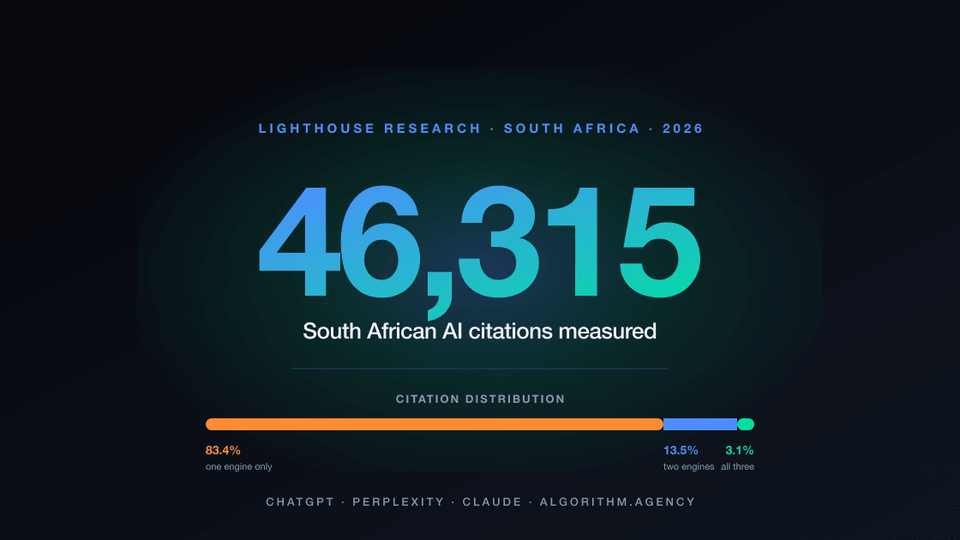
The dataset: 8,242 LLM responses, 46,315 unique domain-citations. To our knowledge, the largest published proprietary AI citation dataset focused on the South African market.
The headline finding: 83.4% of cited domains appeared on only one platform.
The fragmentation finding
Of the 46,315 unique citations across the three engines:
- 83.4% appeared on only one platform (platform-specific)
- 13.5% appeared on two of three platforms
- 3.1% appeared on all three platforms
The global Qwairy benchmark study (118,000 prompts across four engines including Google AI Mode) found 89% of citations were platform-specific. Our three-engine South African figure of 83.4% sits in the same range. Adding a fourth engine, which we will do when Lighthouse integrates Gemini and AI Mode, would almost certainly push it past 89%.
The implication is the same in both datasets. The shared sources that anchored SEO only weakly anchor AI search. Each engine has its own list of sources it trusts, and the lists do not overlap.
For the argument behind this finding, see the companion piece: Why your SEO does not make you visible in ChatGPT.
The South African sector picture
Sector matters. Categories with strong, established authoritative sources drive higher cross-engine consensus. Categories without those anchors leave each engine to invent its own credibility ranking. Six sectors with meaningful sample sizes are shown below, ranked by cross-engine overlap.
- Financial Services: 455 prompts, 7,510 unique domains, 18.7% overlap (highest consensus)
- Education and Conferences: 20 prompts, 335 unique domains, 17.0% overlap
- Retail and Ecommerce: 181 prompts, 3,007 unique domains, 15.7% overlap
- Telecoms and Connectivity: 167 prompts, 2,607 unique domains, 15.1% overlap
- Travel and Hospitality: 10 prompts, 194 unique domains, 13.9% overlap
- Marketing and Agency: 60 prompts, 1,064 unique domains, 10.8% overlap (most fragmented)
Financial Services tops the list at 18.7% overlap. The reason is structural. SARS, Standard Bank, FNB, Allan Gray and Old Mutual are unavoidable South African financial authorities. All three engines reach for them, which produces consensus.
Marketing and Agency comes last at 10.8%. There is no SARS of South African marketing. Each engine constructs its own credibility map from a fragmented industry web, and almost none of those choices line up. Even the highest-consensus sector still has 81% platform-specific citations. Sector strength reduces the problem. It does not solve it.
Each engine has a different citation personality
Volume, breadth and uniqueness vary by an order of magnitude across the three engines.
Perplexity
8.34 average citations per response. 100% of its responses cite at least one source. 70.5% of its cited South African domains do not appear in the other two engines' answers. Cites the largest absolute pool of South African sources.
ChatGPT
7.42 average citations per response. 99.6% citation coverage. 76% of its cited South African domains are unique to ChatGPT, the highest of the three. The most idiosyncratic engine in its source choices.
Claude
5.95 average citations per response. 100% citation coverage. 60.4% of its cited South African domains are unique to Claude. The most aligned with consensus, but most aligned still means 60%.
The 40% spread in citation volume across the three engines is its own finding. Before you even look at which domains each one chooses, the engines disagree on how many sources are worth citing.
Top five South African sources, per engine
The most-cited South African domains across the dataset, per engine, with citation counts. The patterns are distinct enough that each engine effectively answers from a different version of the South African web.
ChatGPT: encyclopedic and community-first
- en.wikipedia.org (417 citations)
- reddit.com (309)
- standardbank.co.za (132)
- learn.microsoft.com (125)
- rateweb.co.za (108)
Wikipedia and Reddit beat every local source. Treats community discussion as a credible signal. A South African brand with no Wikipedia entry and no Reddit signal has a structural ChatGPT visibility problem before any on-site work begins.
Perplexity: video and big-brand
- youtube.com (666 citations)
- oldmutual.co.za (238)
- standardbank.co.za (237)
- allangray.co.za (230)
- personal.nedbank.co.za (196)
YouTube dominates by a wide margin. Then established South African financial institutions. The most South African of the three in its source mix. If your category has no useful video coverage, you are ceding Perplexity visibility to whoever decides to make it.
Claude: niche specialist publications
- bridgement.com (118 citations)
- oldmutual.co.za (112)
- allangray.co.za (102)
- smesouthafrica.co.za (101)
- supaquick.com (98)
No global aggregators in the top five. Cites SME-focused and specialist sources that the other two engines largely ignore. Editorial relationships with niche specialist publications buy Claude visibility that ChatGPT and Perplexity will not give you.
Three engines. Three almost completely different definitions of a credible South African source. A South African brand with strong Wikipedia and Reddit presence has structural ChatGPT visibility built in. A brand with deep YouTube content has structural Perplexity visibility. A brand cited regularly by SME-focused publications has structural Claude visibility. These are not the same brand-building investments, and they do not naturally compound across engines.
What this means for South African brands
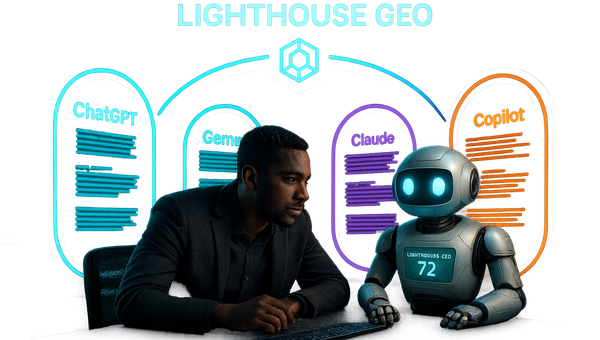
The single most expensive mistake we see South African brands making in 2026 is treating AI search as one channel. There is no AI search. There are ChatGPT, Perplexity, Claude, Gemini and at least four more, each with a different definition of a credible South African source, each weighting third-party signals differently, each citing a different version of your category.
The work that follows from that is per-engine, not aggregate. The audit is per-engine. The credibility map is per-engine. The third-party publication strategy is per-engine. The schema and content design choices are per-engine. Optimise for AI as a single instruction is the agency equivalent of optimise for the internet. It does not survive contact with the data.
The 90-day action plan
Six steps. All practical. Built from the work we run for Lighthouse clients every week.
NOW: Measure per engine, not in aggregate
An AI visibility score averaged across engines hides the real picture. Run a separate visibility check on ChatGPT, Perplexity and Claude, and Gemini when you can. Look at where each one cites you and where each one does not. The gap between them is your work plan.
NOW: Build a per-engine credibility map for your category
For your top 25 commercial prompts, capture which domains each engine actually cites. That map tells you which third-party domains you need a presence on per engine. It is rarely the same list across the three.
30 DAYS: Fix your Wikipedia and Reddit footprint
If you sell to a South African audience that uses ChatGPT, your Wikipedia entry and Reddit presence matter more than most local SEO advice will tell you. Audit both. Brief whoever needs to brief. This is structural ChatGPT visibility work.
30 DAYS: Diversify content format for Perplexity
Perplexity cited YouTube 666 times across our South African dataset, more than twice the next domain. If your category has no useful video coverage, you are ceding Perplexity visibility to whoever decides to make it.
60 DAYS: Build authority on the niche specialist publications Claude trusts
Claude cites SME South Africa, Bridgement, Supa Quick and similar specialist sources that ChatGPT and Perplexity ignore. Track which specialist domains apply in your category. Editorial relationships with those publications now buy Claude visibility for years.
90 DAYS: Establish weekly per-engine monitoring
Citation behaviour shifts when any engine updates its retrieval stack. Quarterly audits will miss the inflection. Weekly per-engine monitoring (via API, not scraping) catches the shift in time to respond. This is what Algorithm Lighthouse was built to do for South African brands.
Methodology
The sample
- 43 South African client projects in Lighthouse
- 50 completed Lighthouse runs, April to May 2026
- 2,737 unique prompts answered by all three engines
- 8,242 LLM responses captured in full
- 46,315 unique domain-citations measured
- Sectors covered: Financial Services, Retail and Ecommerce, Telecoms, Marketing, Travel, Education and others
The mechanics
- Every prompt issued to ChatGPT, Perplexity and Claude in the same time window
- Provider responses retrieved via API, not scraping
- Citations parsed from each engine's native response format
- Domains normalised (www stripped, lowercased, trailing slashes removed) before comparison
- Cross-engine overlap calculated per prompt, then aggregated across the dataset
- Gemini and AI Mode not yet included (integration in progress)
Lighthouse is Algorithm's proprietary GEO visibility platform. It runs API-based monitoring of brand and competitor citation behaviour across the major AI engines, then synthesises the result into a per-engine intelligence layer that informs every GEO recommendation we make for clients.
To our knowledge, this is the largest published proprietary AI citation dataset focused on the South African market. It is also the first to disaggregate the picture per engine and per sector at this scale. We built Lighthouse because no available platform was producing reliable South African data. The reports we publish from it are a by-product of using it in production for our clients every week.
See the data for your own category
Algorithm runs a free Lighthouse visibility audit for South African brands. Same methodology as this report. You see exactly which domains each engine cites about your category, where you appear, and where the structural gaps sit. No template. Real data from your category. Get in touch to book one.