There is a reason most agencies do not have a named methodology.
A named methodology creates accountability. It says: this is exactly how we work, these are the deliverables at each stage, and this is how you measure whether we are delivering them. That level of specificity is uncomfortable for an agency that is figuring things out as it goes.
We built Algorithm around a named methodology because we believe that accountability is the foundation of genuine performance. If we cannot name our process, draw it, and show you how it improves every month, we have not earned your trust.
The Algorithm RACE Framework is that process.
What is the RACE framework?
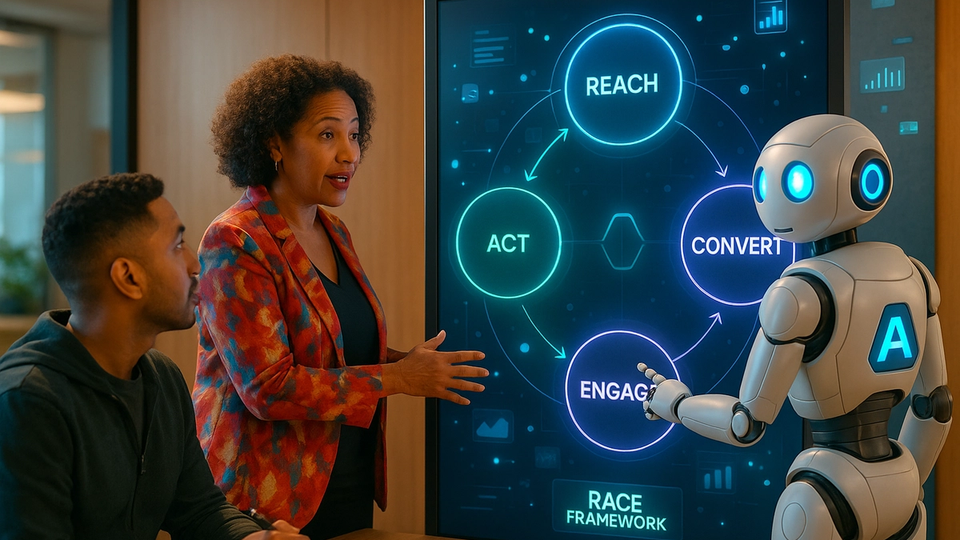
RACE is the four-stage operating model inside the Algorithm Performance Engine. Every service we offer, every team member we deploy, every piece of data we track sits within one of four connected stages:
- REACH: Turn visibility into qualified demand
- ACT: Turn traffic into engaged prospects
- CONVERT: Turn prospects into paying customers
- ENGAGE: Turn customers into compounding growth
These four stages are not sequential steps in a funnel. They are concurrent, continuously operating components of a system. ENGAGE-stage data about customer lifetime value informs REACH-stage investment decisions. CONVERT-stage testing results inform ACT-stage UX design. The system learns from every cycle.
REACH: turn visibility into qualified demand
REACH is the engine's entry point. It is everything Algorithm does to ensure that the right people, your actual buyers in your actual market, find your brand at the moment they are most ready to engage.
In 2026, REACH is not just an SEO and paid media question. It is also an AI visibility question.
When someone types a question into ChatGPT, Gemini, or Perplexity and your brand does not appear in the answer, you have a REACH problem. When 69% of Google searches end without a click (SparkToro/Datos, 2025), the brands that exist in AI-generated answers are capturing demand that never reaches the traditional search results page. This is the thesis behind why your SEO does not make you visible in ChatGPT.
REACH encompasses:
- Market Share Analysis: The commercial baseline: where you stand in your market relative to competitors, across every search surface. This is slide one of every Algorithm engagement.
- SEO & AI Discovery (AEO/GEO): Traditional organic search optimisation alongside Answer Engine Optimisation (AEO) and Generative Engine Optimisation (GEO), ensuring your brand appears in both traditional search results and AI-generated answers.
- Paid Media: Structured, signal-optimised paid search, social, and programmatic, with Google Premium Partner access and a five-year track record in the South African market.
- Social Engine Optimisation: Social platforms are now search engines. TikTok, Instagram, LinkedIn, and YouTube all operate as discovery environments and each rewards different signals. Social Engine Optimisation treats these platforms with the same rigour as traditional SEO.
ACT: turn traffic into engaged prospects
Traffic without engagement is money spent on empty visits. The ACT stage is where Algorithm ensures that the demand REACH creates is captured and turned from awareness into active consideration and qualified intent.
ACT is where most marketing systems lose the most value. You have paid to get someone to your website. You have earned their click. And then a slow page, an unclear value proposition, or a frustrating navigation path sends them back to Google.
ACT covers:
- User Experience (UX): The quality standard for every digital touchpoint. Not just visual design. Information architecture, navigation logic, mobile performance, and the micro-moments that determine whether a visitor stays or leaves. We unpack this in detail in why UX is central to SEO.
- Landing Page Optimisation: Every paid media campaign points to a destination. The quality of that destination determines whether the campaign pays for itself.
- Content Strategy: The information architecture that moves a visitor from awareness to consideration. What they read, watch, and engage with between first visit and first contact.
- Lead Capture Architecture: How you convert an engaged visitor into an identifiable prospect, form design, gating strategy, progressive profiling, and the balance between friction and qualification.
CONVERT: turn prospects into paying customers
The CONVERT stage closes the gap between lead and revenue. It is where Algorithm's work becomes commercially accountable.
Most agencies end their meaningful contribution at the top of the funnel. They report on the traffic they drove, the leads they generated, the impressions they earned. The CONVERT stage demands something different: proof that those activities produced commercial outcomes.
CONVERT covers:
- Conversion Rate Optimisation (CRO): A hypothesis-driven, revenue-attributed testing programme. Not isolated A/B tests, a systematic programme that compounds learning over time and measures success in revenue per visitor, not just conversion rate.
- Sales Alignment: The connection between marketing-generated leads and the sales process that converts them. Where marketing stops and sales starts is often where commercial accountability falls through the cracks. Algorithm closes that gap.
- Revenue Attribution: The data infrastructure that connects marketing activity to closed deals. Conversion API, CRM integration, offline conversion imports, and attribution models that account for multi-touch journeys and cookieless environments.
ENGAGE: turn customers into compounding growth
Acquisition is the beginning. ENGAGE is what makes the system compound.
A business that acquires a customer once and never invests in that relationship is on an acquisition treadmill, constantly spending to replace customers who drift or churn. ENGAGE breaks that pattern.
The financial arithmetic is straightforward. Increasing customer retention by 5% typically increases profit by 25% to 95% (Harvard Business Review). The ENGAGE stage is where that arithmetic is realised.
ENGAGE covers:
- Retention Strategy: Understanding why customers stay and building the marketing and product infrastructure that makes staying the easiest choice.
- Lifecycle Automation: Personalised, data-led communication that responds to customer behaviour, reactivating dormant accounts, accelerating second purchases, and identifying advocacy opportunities.
- Data & BI: The intelligence layer that feeds ENGAGE insights back into REACH decisions. What the customer data tells us about who to acquire next, where to find them, and what will convert them.
Why frameworks beat individuals: the IP argument
Here is a question worth asking your current agency: what happens to your performance if your account lead leaves?
If the honest answer is 'it gets worse', your agency has a structural problem. Your marketing performance is dependent on an individual, not a system. This is the same diagnosis we make in why your marketing isn't underperforming, your system is.
Algorithm's RACE framework was designed specifically to avoid this dependency. The methodology, and the commercial outcomes it produces, lives in the framework, not in the people who run it. Every Algorithm engagement follows the same four-stage process. Every deliverable is defined. Every optimisation cycle produces documented learning that feeds back into the system.
When one person leaves, the engine keeps running.
How the RACE framework integrates AI visibility
The RACE framework was designed to evolve with the discovery landscape, and the discovery landscape has changed dramatically.
In the REACH stage, AI-generated recommendations are now a primary channel. When 1 billion users interact with ChatGPT weekly (OpenAI, March 2026), and AI referral traffic converts at a meaningfully higher rate than Google organic, a performance marketing system that does not account for AI visibility is missing the highest-converting discovery channel in the modern web.
AI referral traffic conversion rate, vs 2.8% from Google organic
Lighthouse GEO data, 2026
Algorithm's REACH stage now explicitly includes:
- Answer Engine Optimisation (AEO): Structuring content to appear in AI-generated direct answers to commercial queries.
- Generative Engine Optimisation (GEO): Optimising for citation authority across AI providers, the domains and content formats that LLMs treat as authoritative in your category.
- Lighthouse GEO: Our proprietary AI visibility tracking tool, measuring brand presence across ChatGPT, Gemini, Claude, and Perplexity in real time. See how we measured 46,315 AI citations in South Africa and what it revealed about per-engine credibility, or read the case for Lighthouse GEO as the intelligence layer behind modern brand discovery.
A framework that compounds
The most important characteristic of the RACE framework is not what it produces in the first month. It is what it produces over twelve months.
Because data flows between stages, ENGAGE insights feeding REACH decisions, CONVERT learning informing ACT design, every month the system has more information to act on. The campaigns get more targeted. The landing pages convert better. The customers stay longer.
This is the compounding effect of a performance marketing system. Channels optimised in isolation plateau. A system, properly run, continues to improve.
Frequently asked questions
What does RACE stand for in marketing?
In the Algorithm RACE Framework, REACH = drive qualified demand through all channels; ACT = turn traffic into engaged consideration; CONVERT = close the gap between lead and revenue; ENGAGE = retain and compound growth through lifecycle and data.
How is the RACE framework different from a marketing funnel?
A marketing funnel is linear and ends at conversion. The RACE framework is cyclical: data from the ENGAGE stage feeds back into the REACH stage, creating a compounding system rather than a one-directional flow. It also explicitly integrates AI-driven discovery in the REACH stage, which traditional funnel models do not account for.
Does the RACE framework work for B2B businesses?
Yes. The RACE framework was designed for commercial outcomes regardless of business model. For B2B businesses, the CONVERT stage places greater emphasis on sales alignment and long-cycle attribution, and the ENGAGE stage typically involves higher-value lifecycle management. The framework adapts to the sales cycle. The principles are the same.
Want to see the RACE framework applied to your business? Start with a diagnosis.