Here's a question we get asked in almost every first meeting: "Should we be doing SEO or GEO?" It's a fair question. It's also the wrong one. Asking whether you need SEO or GEO is a bit like asking whether a car needs an engine or wheels. You need both. They do different jobs, but neither one gets you anywhere on its own.
So let's slow down and actually explain this properly. No jargon walls, no acronym soup. Just what's actually changed, why it matters for your business, and how we build it.
The way people find things has changed. A lot.
For about twenty years, finding a business online meant one thing: typing something into Google and scrolling through the results. That was it. That was the whole game. If you ranked high on Google, people found you. If you didn't, they didn't.
That's not how it works anymore. Think about how you actually search for things today. You might ask ChatGPT to recommend a few options. You might watch a TikTok review before you buy anything. You might search YouTube instead of Google because you'd rather watch someone explain it than read about it. By the time you do open Google, you've probably already half made up your mind.
Here's the number that should worry every business owner: seven out of ten Google searches now end without anyone clicking on a single result. People are getting their answer right there on the search page, or somewhere else entirely, and never visiting a website at all.
And the people who do click through from somewhere like ChatGPT buy at a much higher rate than people who click through from a regular Google search. Roughly five times higher. Why? Because by the time someone asks an AI assistant for a recommendation, they've already done their homework. They're not browsing anymore. They're deciding.
The simplest way to think about it
Google used to be a menu you'd scroll through yourself. Now it's more like a waiter telling you what's good tonight. If you're not the dish the waiter recommends, it doesn't matter how good your menu description is.
Google used to be a menu you scrolled through yourself. Now it's a waiter telling you what's good tonight.
What we actually sell: Social Engine Optimisation
Here's the thing. At Algorithm, we don't really sell "SEO" anymore. Not in the old sense. What we sell is something bigger, and it has a name: Social Engine Optimisation.
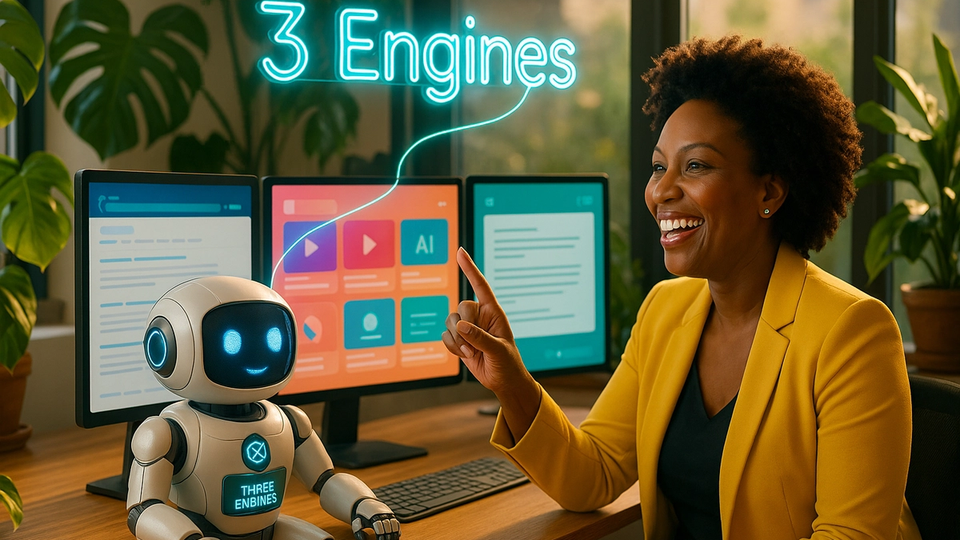
Here is what it means in plain terms. The old idea was that there was one place people searched: Google. That's no longer true. People now discover, compare and decide across lots of different places. So instead of treating Google as the only game in town, we treat the whole landscape as one connected system. Three types of "engines," working together, not three separate jobs.
Search engines: the foundation
Google, Bing.
This is the traditional stuff: making sure your website is fast, well-organised, and easy for search engines to understand. It's still necessary. It's just not enough on its own anymore.
Social engines: discovery and validation
TikTok, YouTube, Reddit, Meta, Pinterest.
We treat these as search engines now, not just places people scroll for fun. This is where people actually go to find things and check if they're any good before they buy. If you're not showing up here, you're invisible at the exact moment someone is deciding whether to trust you.
AI engines: the GEO discipline
ChatGPT, Perplexity, Gemini, Google AI Overviews, Copilot.
This is the newest and fastest-moving piece. Instead of giving someone ten links to click through, these tools give one single answer. If your business isn't the one the AI trusts enough to mention, you simply don't exist in that answer. There's no page two to hide on.
Three different engines. One job: making sure your business shows up, gets recognised, and gets recommended, wherever your customers are actually looking. That's Social Engine Optimisation. It's not three separate strategies bolted together. It's one connected plan.
The thing that ties it all together: entities
This next part matters most. There's one idea that connects everything we've just talked about, and it's called an entity.
Forget the technical-sounding name for a second. Think of an entity as one clear, distinct part of your business that deserves its own spotlight. Not your whole company lumped together. One specific thing your business does, sells, or specialises in.
Let's make this really concrete. Say you run a private hospital group. You probably don't just do "healthcare." You do Cardiology. You do Maternity. You do Oncology. Each one of those is a separate entity, because each one has its own patients, its own questions people ask, its own competitors, and its own way of measuring success. A new mum researching maternity wards isn't thinking about cardiology, and vice versa.
Or say you run an online store. You're probably not selling "stuff." You're selling Power Tools. Hand Tools. Outdoor Furniture. Lighting. Same idea. Each one is its own world, with its own customers and its own questions.
A private hospital group might split into:
- Cardiology
- Maternity
- Oncology
- Emergency Care
An online store might split into:
- Power Tools
- Hand Tools
- Outdoor Furniture
- Lighting
Why does this matter so much? Because when an AI assistant is asked "which is the best maternity hospital in Johannesburg," it isn't doing a fresh Google search in that moment. It's drawing on everything it's ever learned about hospitals, maternity care, and your specific brand, and it's deciding who to recommend based on how clearly it understands who you are and what you're good at.
If everywhere it looks, your maternity unit is described the same way, by you and by other trusted sources, it builds real confidence. If your website calls it one thing, a review site calls it something else, and a news article describes it differently again, the AI gets confused. And a confused AI doesn't take the risk of recommending you. It plays it safe and recommends someone clearer instead.
How we actually build one of these entities
Once we've picked an entity to focus on, say, your Maternity unit, we don't just write one page about it and call it done. We build it out properly, like a little neighbourhood of content that all supports each other.
There's one main page that acts as the home base for that topic. The clearest, most complete page about maternity care your hospital offers. Everything else points back to it.
Then there are the pages closest to actually booking or enquiring. These go live first, because they're the ones that actually bring in business while everything else is still being built.
Then come the pages that go a bit deeper, comparing options, answering harder questions, helping someone make a decision.
And finally, the pages that bring new people in right at the start of their search. The educational stuff. The articles that answer the basic questions someone might Google long before they're ready to book anything.
Build it entity by entity like this, and two good things happen. First, you can see exactly where the budget goes and exactly what it produced; nothing vague, nothing hand-wavy. Second, every bit of content you build does double duty. It helps you rank on Google, and it helps AI tools understand and trust you. Same work, two wins.
How this actually gets priced and built
This is the part that makes Algorithm different from a typical agency, so it's worth explaining clearly.
You are buying entities, not hours
We don't sell you a vague bucket of hours and hope for the best. We price the actual unit of authority we're building, the entity. Start with one entity if that's what makes sense for your business right now. Want to move faster and own more ground? Add more entities. More entities simply means more of your market becomes yours, faster.
The thinking and the writing are two separate things
The base package covers the strategy, the plan, the technical groundwork, and the ongoing measurement through our Lighthouse tool, all built around your chosen entity. If you also want our team to actually write the content for you, that's available as a separate add-on. Some clients have great writers already and just need the strategy. Others want us to handle everything. Either way works.
There are two phases: building, then compounding
First comes Foundation. This is where we actually build everything out properly for your chosen entities. Once that's done, you move into Amplify, where the same investment starts working even harder, because the foundation is already in place and now we're building on top of it rather than starting from scratch. The value you get for the same spend keeps increasing the longer you stay with us.
Why this matters for you
This isn't multi-channel marketing, where you run a separate, disconnected strategy for every platform and the effort never really adds up. It's one unified push. Every engine, recognising the same clear, consistent picture of your business, building authority everywhere at once instead of in scattered, separate pockets.
The good news: most of the work overlaps anyway
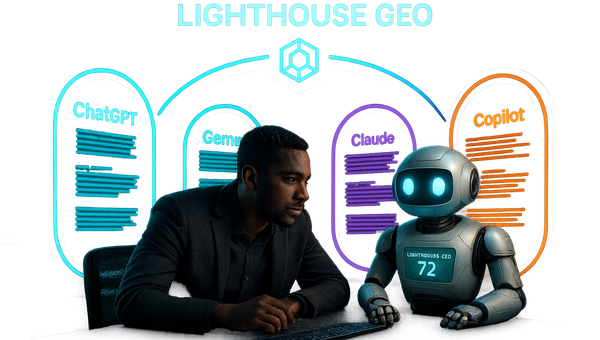
So what's actually different? Really, just three things. How we measure success (Google has its own tools, but nothing tells you whether ChatGPT mentioned you yesterday, which is why we built our own tool, Lighthouse, to track that specifically). How we write certain content (a clear, quotable fact works brilliantly for AI tools, where a vague paragraph doesn't). And what we're aiming for (a Google ranking is one thing, but actually being the brand an AI recommends by name is a different finish line, even though most of the road to get there is the same).
Why this matters even more in South Africa right now
We ran our own research on this. We tested 2,737 different real questions across ChatGPT, Perplexity and Claude, covering 43 South African brands across industries like banking, retail, travel and education.
of people who click through from AI actually buy, versus 2.8% from Google
Algorithm Lighthouse research across 2,737 prompts in the South African market
Two more numbers from the same study worth sitting with: 83.4% of the sources AI used were trusted by only one platform, not all of them. And 46,315 individual mentions and citations were measured across the South African market.
What that tells us is interesting. ChatGPT, Perplexity and Claude each trust their own different set of sources. So having great Google rankings doesn't automatically mean AI tools know who you are. You could be ranking well on Google and be invisible in ChatGPT at the same time.
Here's the silver lining though. South Africa doesn't have nearly as much information online as bigger markets like the UK or US. That sounds like a disadvantage, but it actually works in our favour. With less noise out there, every good, clear, credible mention of your brand counts for more. Most categories here are still wide open. The businesses that get this right now are going to have a real head start that gets harder and harder for everyone else to catch up to.
How we actually roll this out, step by step
We don't believe in vague retainers where you're not quite sure what you're paying for each month. Everything runs through the same five clear steps, every single time, whether it's your first entity or your tenth.
00. Kick-off. We sit down together, figure out exactly what you need, get access to your accounts and tools, and lock in a plan. By the end of the first week, you know exactly what's happening next.
01. The plan. We figure out which entity to focus on first, look at what your competitors are doing, and run your brand through Lighthouse to see exactly where you stand on Google and on AI tools today. You get a clear, signed-off plan before any building starts.
02. The health check. While the plan is being finalised, we run a full check-up on your website. Is it fast? Is it easy for Google and AI tools to read? Anything broken gets flagged here so it doesn't slow down the real building work.
03. Building the entity. This is where the actual work happens. Over four weeks, we build out everything for your chosen entity, the main page, the pages closest to bringing in business, and the supporting content around them. The pages most likely to bring you customers go live first.
04. Spreading the word. Once your entity is built and live, we work on getting other trusted websites and publications to mention you. Every one of those mentions helps you on Google and helps AI tools trust you too. Same effort, both jobs done.
One plan, one budget, both worlds covered
Most of what we just described would already be happening in any properly run SEO programme. What we add is making sure it's all aimed at AI tools too, and that we're actually measuring whether it's working, every single week, through Lighthouse. One plan. One budget. Results you can see on Google and in AI tools.
Questions people usually ask us
Do I have to choose between SEO and GEO?
No, and please don't. Around 70 to 80 percent of solid SEO work already helps you with AI tools too. The smart move is doing both together as one plan, not picking a side.
What's an entity again, in plain English?
It's one clear, specific part of your business that deserves its own focused attention. Not your whole company as one, but a particular service, product category or area you specialise in that you want to own. We build your online presence one of these at a time, properly, rather than spreading effort thin across everything at once.
Is AI going to replace Google completely?
Not any time soon. Google still sends the most everyday traffic to most businesses. What's changed is that AI tools have become a serious second front you also need to win, especially because people who come from AI tools tend to actually buy.
How do you actually know if it's working?
Through our own tool, Lighthouse. It checks every week exactly how ChatGPT, Gemini, Perplexity and other AI tools are talking about you, and compares it to your competitors. You're not guessing. You can see it in black and white.
How long until I actually see something happening?
You'll usually start seeing movement in AI mentions within four to eight weeks. The real compounding results, where you're consistently showing up, tend to land around three to six months in. Worth the wait. AI traffic converts roughly five times higher than Google traffic.
The mistakes we see businesses make
Where to go next
If you want the more detailed, technical version of everything we've covered here, our full guides live at algorithm.agency/guides.
Curious where your business actually stands right now in ChatGPT, Perplexity or Gemini? We offer a full AI audit across your business, and we're an easy email away: algorithm.agency/need-assistance.
Algorithm Agency. We're a South African performance marketing agency. We help businesses show up properly, on Google, on social platforms, and in AI tools, all as one connected plan rather than three separate scrambles. Every project starts with us actually understanding your business first. Turn Potential Into Performance.