Most marketing leaders still picture AI search the way they pictured Google a decade ago. As a system that indexes pages, ranks them, and returns the best ones. That is not how it works. The shift from indexing to understanding is the single biggest reason why brands that ranked well in Google can find themselves missing from ChatGPT, Gemini and Perplexity for the same query.
To compete in AI search, the question is no longer is my page indexed. The question is does the model know who we are and what we stand for. That question lives at the entity layer. If a CMO is going to make one investment in 2026 that changes how their brand appears in AI answers, this is it.
What is an entity?
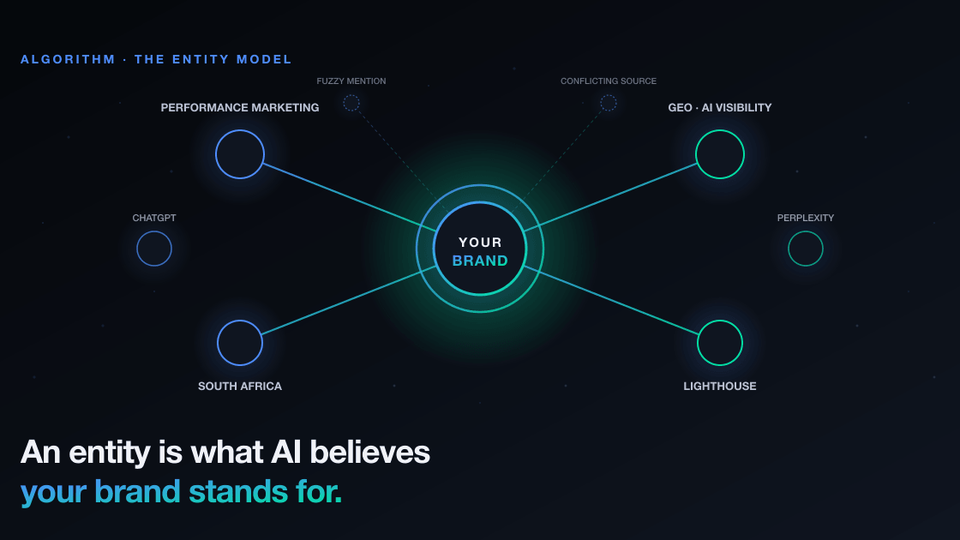
In the AI search world, an entity is a thing the model recognises as a discrete concept and has built a profile around. A brand, a person, a product, a place, a category. Each entity has a centre of mass: the topics and other entities it is most associated with, the descriptions it most commonly carries, the sources that most often reference it.
The reason this matters: AI engines do not retrieve and rank pages the way Google did. They retrieve entities and the relationships between them, then construct an answer around what they know to be true about each one. The model is not looking for the best page about your business. It is looking for what it believes your business is, and then writing about that.
If the model has a clear, confident entity for your brand, it will cite you. If your entity is fuzzy, conflicting or absent, it will not. That is the gap that Generative Engine Optimisation (GEO) closes.
Think of it less like a database lookup, and more like building a reputation. The more sources that agree on what your brand is and what it stands for, the more confidently the AI can place it, and the richer the profile it builds around you.
How AI builds the profile
AI sits on an almost incomprehensible amount of data. To make that useful, it needs structure. A filing system does not work, because reality is too messy, and entities connect to other entities in overlapping, evolving ways. Instead, the model finds patterns. It watches how entities co-occur, over and over, across millions of sources. Topics, neighbourhoods and relationships emerge from that pattern, not from a tag or a category somebody applied.
A brand that consistently appears alongside cloud security and enterprise software gets pulled into that neighbourhood. A brand that shows up inconsistently, or in conflicting contexts, stays fuzzy. The more consistent the signal across independent sources, the clearer the picture, and the richer the profile the model can build around it.
This is reputation, not registration. You do not declare an entity into existence. You earn one by being talked about, in the same way, by enough independent sources for the model to draw the line. That is the engine behind every citation decision ChatGPT, Gemini and Perplexity make.
Why this matters for GEO
GEO is the discipline of shaping how AI engines understand and cite your brand. Every tactic, every schema decision, every editorial placement is in service of one question: is the model confident enough about who we are to cite us? Three things follow from treating entities as the unit of work, not pages.
01. Mentions matter more than rankings
A page that ranks position one in Google can still be invisible across all three of the AI engines we measured in South Africa. The reason: rankings reward your page. Citations reward your entity. The model is not deciding which of two pages is the best answer, it is deciding which entity belongs in the answer at all.
The deeper version of this argument, with the data, is in our piece on why your SEO does not make you visible in ChatGPT. The summary: ranking is no longer a proxy for AI visibility, and a strong entity beats a strong page.
of South African AI citations come from sources that only one engine trusts.
From the 46,315 citations we measured across ChatGPT, Perplexity and Claude. Each engine builds its own entity profile from its own preferred sources. Source: Algorithm Lighthouse, 2026.
02. Consistency beats volume
Volume helps. Consistency wins. Ten sources describing you in the same way are worth more than fifty sources contradicting each other. AI averages, in effect. If half the web calls you a performance marketing agency and half calls you a digital marketing agency, the model has two competing labels and is less confident about either.
This is why we tell clients to pick a position and hold it across every external surface. Boilerplate matters. Bio copy matters. Press positioning matters. The signal needs to be the same wherever the model finds you, because the model is not reading any single source, it is averaging the lot.
of cited domains per engine are unique to that engine in South Africa.
ChatGPT, Perplexity and Claude each build entity profiles from their own preferred publisher set. The Wikipedia entry, the YouTube clip and the SME-focused publication serve different engines. Source: Algorithm Lighthouse.
03. Third-party sources do most of the work
Your website is one input. It is rarely the dominant one. The model trusts third-party sources more than your own marketing copy, because external corroboration is what proves the pattern is real. A major publication describing you as an AI marketing leader carries weight your own homepage cannot. The signal is independent.
This is why our GEO playbook starts with editorial visibility, expert positioning, and entity-rich profiles on the platforms each engine reads. The cornerstone here is our guide to Generative Engine Optimisation, which lays out the full discipline. The work belongs in the plan of every CMO who cares about AI search.
What clarifies an entity, and what confuses it
Five signals build clarity. A handful of common moves erode it. The first list is what you spend your year doing. The second is what you stop tolerating.
The South African angle
Most of the entity advice published globally assumes a heavily-saturated web. South Africa is the opposite. The model often has fewer signals to work with, which sounds like a problem and is actually a window. With less existing evidence, every new credible mention disproportionately shapes how the model sees you.
The brands moving fast on this in the local market right now (mostly in financial services, where SARS, Standard Bank, FNB, Allan Gray and Old Mutual anchor strong entity profiles already) are accumulating compounding visibility. The brands waiting are not standing still. They are slipping. Most categories outside finance are still wide open. That is why we prioritised this for our clients from 2024 and built Lighthouse GEO to measure the work week by week.
With less existing evidence in the South African web, every new credible mention disproportionately shapes how the model sees you. That makes 2026 the window.
What a CMO should do in the next 90 days
This is not a technical SEO checklist. It is an entity-building plan, and it sits across PR, content, and the website. Five steps, in order.
- Define the one-line entity. What is your brand, in one sentence, in language the model can categorise. Pick a position you can defend, and lock it across every external surface.
- Audit your external footprint. Where do you appear, how are you described, and where do those descriptions contradict each other. The contradictions are the first thing to fix.
- Fix the structured data. Organisation schema on every key page. Person schema for the founders and senior leaders. sameAs links from every owned profile to authoritative external ones.
- Win the third-party signals. Editorial in publications the AI engines actually cite for your category. Speaking slots. Industry recognition. The right Wikipedia entry, where applicable.
- Measure entity visibility, not page rankings. Track how AI engines describe you, and which sources they pull from, across the engines that matter for your audience. The companion SEO vs GEO guide covers what changes about measurement.
This is the work we run for clients through Algorithm's GEO agency and feed back through Lighthouse GEO. The full per-engine credibility maps for the South African market, with sector breakdowns, sit in our research piece on the 46,315 AI citations we measured locally. Use it as the briefing document for the conversation with your team.
The next step
If you want to see how AI engines describe your brand today, the fastest path is a Lighthouse visibility audit. Same methodology as the research. You see exactly which sources each engine pulls from for your category, where you appear and where you do not, and which signals are pulling the model towards or away from confidence in your entity. Get in touch to book one.