Your buyers have stopped searching. They have started asking. Instead of typing keywords into Google and scanning a results page, a growing share of purchase decisions now begin with a question typed into an AI assistant. "Which performance marketing agency should I consider?" "What is the best option for enterprise SEO in South Africa?" "Who are the leaders in paid media?" The AI synthesises everything it trusts and names two or three brands. If yours is not among them, you are invisible at the most commercially significant moment in the buying journey.
Traditional SEO tools cannot see any of this. They were built for Google's ranked-list model: keyword positions, click-through rates, backlink profiles. AI engines work differently. They retrieve, synthesise and name. The mechanics are fundamentally different, and so are the winners. Brands that dominate page one of Google are frequently absent from AI-generated answers in the same category. That gap is widening, and your SEO does not transfer to AI search the way most teams assume.
The measurement gap is not a future risk. It is costing brands pipeline today. Algorithm built Lighthouse GEO to close it.
Lighthouse GEO: AI visibility intelligence for the recommendation economy
The AI assistants your buyers use every day are naming brands, making recommendations and shaping purchase decisions without you seeing any of it. Lighthouse GEO changes that. It is Algorithm Performance's proprietary AI visibility intelligence tool: a complete map of where your brand stands in the AI recommendation layer, across every major provider, for every commercial entity that matters to your business.
The shift your analytics stack cannot see
When someone asks an AI assistant for a recommendation in your category, you have no visibility into whether your brand appears, how you are positioned, or who is winning the conversation instead of you. Traditional SEO tools were built for ranked lists and click-through rates. AI engines retrieve, synthesise and name. The measurement frameworks are fundamentally different, and most marketing teams are using the wrong instruments.
The commercial case is direct. According to SparkToro and Datos (2025), 69% of Google searches now end without a click. ChatGPT has more than one billion weekly active users (OpenAI, March 2026). And AI referral traffic converts at 14.2% compared to 2.8% from Google organic, five times higher. That last number deserves attention. The highest-converting discovery channel on the web is the one most brands are not measuring, not optimising for, and not even aware they are losing ground in.
AI referral traffic converts five times higher than Google organic
14.2% conversion from AI referrals vs 2.8% from Google organic (SparkToro and Datos, 2025)
This is not a future scenario. It is the current state of discovery. And for most brands, it is a blind spot.
How Lighthouse GEO works: three stages, human-approved at every step
Lighthouse GEO is not a black-box algorithm. Every stage is transparent, validated with your team and designed to produce data you can act on immediately. There are three stages: Discover, Generate and Measure.
Stage 1: Discover
Algorithm crawls your website, sitemap and ranked keywords to identify the commercial entities where AI visibility drives real revenue for your business. An entity is any product, service or category your brand should own in AI-generated answers. Nothing is assumed. Every entity is verified with your team and prioritised by commercial value before a single query is run. This is the foundation: if you do not know which entities to measure, the data that follows has no strategic value.
Stage 2: Generate
Algorithm constructs the exact prompts your buyers would type into AI assistants, reverse-engineered from commercial intent signals specific to your category and market. Your team validates every prompt before a single data point is pulled. This step is what separates Lighthouse GEO from generic AI monitoring: we measure the questions your actual customers are asking, not generic category queries that bear no relation to real buying behaviour.
Stage 3: Measure
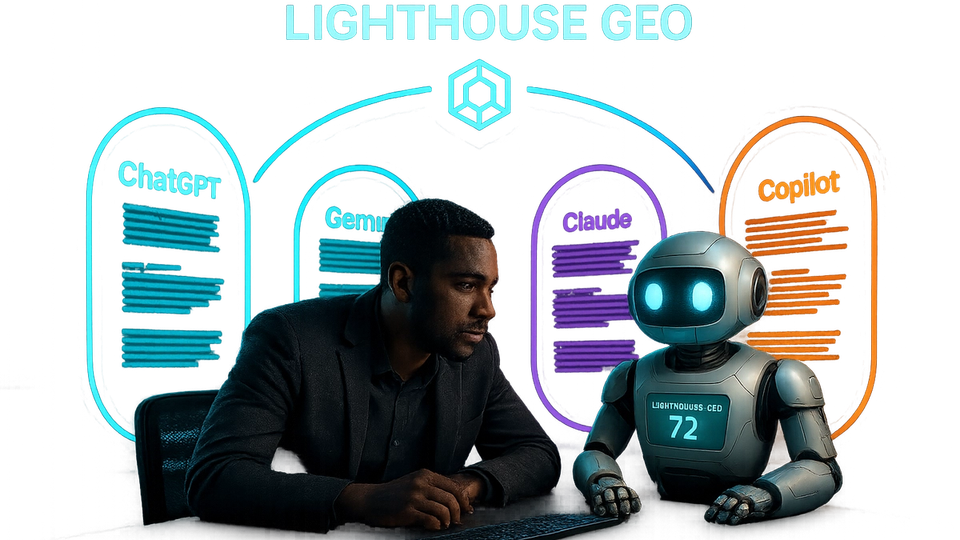
Algorithm queries all four major AI providers and returns per-entity visibility scores, presence rates, share of voice, competitor landscapes, citation authority analysis and a prioritised action plan. ChatGPT, Claude, Gemini and Perplexity are each measured independently so you know exactly where you win and where you do not. The results do not just describe the current state; they tell you precisely what needs to change and in what order.
The four pillars: a complete map of your AI visibility
Lighthouse GEO is built around four interconnected pillars. Together they answer the question every CMO in the recommendation economy should be asking: where does my brand stand when AI decides who to recommend?
Where does your brand stand when AI decides who to recommend?
Entities: The products, services and categories your brand should own in AI-generated answers, mapped and prioritised by commercial value. This is not a theoretical exercise. It is a precise inventory of where revenue is won or lost in the AI recommendation layer. Understanding how AI understands brands as entities is foundational to this work.
Prompts: The actual questions your buyers type into AI assistants, reverse-engineered and mapped to commercial intent signals. Not guessed, not generic. Validated with your team and grounded in how your actual customers think and search.
Providers: ChatGPT, Claude, Gemini and Perplexity, each measured independently so you know exactly where you win and where you do not. Because each provider draws on different sources and weights authority differently, aggregate scores mask more than they reveal. You need the per-provider breakdown.
Citations: The exact domains AI treats as authoritative in your category, which are the sources shaping every answer your prospects receive. Understanding the two data pools AI draws from and which domains are cited is the foundation of any credible GEO strategy. You cannot improve what you cannot see.
What you receive: five deliverables that drive immediate action
Lighthouse GEO is a living intelligence system, not a one-off PDF. It is refreshed continuously as AI providers evolve and your content changes, so your team always has current and actionable data. Five specific deliverables come out of every engagement:
Portfolio Visibility Score: A top-line score with trend tracking over time. Your single source of truth for AI presence across all four providers, comparable period on period so leadership can see progress.
Per-Entity Deep-Dive Reports: Granular breakdowns across all four providers for every commercial entity that matters to your business. Which products appear, which do not, and how your brand is positioned in the answers that do include you.
Competitor Landscape: Who is winning, on which providers and exactly why, so you know precisely where to compete and where the gaps are largest. Knowing you are absent from AI answers is useful. Knowing which competitor is filling that space is what makes it actionable.
Source Authority Map: The exact domains AI trusts in your category and a clear picture of where you need to earn citations to improve your standing. This is the input your content and digital PR strategy has been missing. Our Lighthouse research across 2,737 prompts shows how dramatically these source maps differ between providers.
Prioritised Action Plan: Specific, time-bound recommendations ranked by impact, ready to hand to your content and strategy teams immediately. Not a theoretical report. A working brief.
From sample to system: the compounding advantage of early movers
AI visibility does not work like paid media. You cannot buy your way into an AI-generated recommendation. The brands that appear are the ones whose content has been assessed as authoritative, credible and relevant by the systems making the recommendation. That authority is built over time through the right content, the right citations and the right structural signals.
A full Lighthouse GEO engagement begins with the Discover stage: understanding your commercial entity landscape and the AI visibility position you are starting from. The fastest way to see that starting position is the free GEO Visibility Audit. It is free, takes minutes and shows you exactly where your brand currently appears (and does not appear) in AI search results across the major providers.
Who Lighthouse GEO is built for
Lighthouse GEO is built for any organisation that wants to understand and improve where it stands in the AI recommendation layer:
CMOs and Marketing Directors: A real-time view of commercial marketing performance, ready for any board conversation. No PDF required.
Algorithm client teams: The live operational dashboard that Algorithm's senior specialists use to run and optimise every engagement.
Heads of Digital and Analytics: Granular channel data with commercial attribution, the tool that closes the gap between platform reporting and business outcomes.
The intelligence layer the recommendation economy demands
Marketing attribution has improved dramatically over the past decade. Revenue attribution models, multi-touch analytics, CRM integration. The tools for measuring what happens after a visitor arrives at your website are strong. But the tools for measuring what happens before that visit, specifically in the AI-assisted discovery layer where the recommendation was made, do not exist in most organisations.
Lighthouse GEO is that infrastructure. Built to answer the question that no existing tool could answer: where does your brand stand when AI decides who to recommend?
We did not build it to sell a dashboard. We built it because every Algorithm engagement is accountable for commercial outcomes and you cannot be accountable for outcomes you cannot see in real time.
Find out where your brand stands in AI search. Get your free GEO Visibility Audit.