By Graeme Stiles, CEO, Algorithm
If you've heard the phrase zero-click search and not had time to work out whether it matters to you, here's the short version. More and more searches now end on Google's results page, with the person getting what they needed and never visiting a website. The question for any marketer is how much of your organic traffic that quietly removes, and nobody in this market had measured it.
We have now, and it's changed how I think organic search should be run.
For most of the last 20 years, organic search was a line on a plan. It sat next to paid media and email and social, it had a budget and an owner, and the thing it produced was traffic. You could point at the number and say whether it went up.
That model has quietly stopped working, and the data we've just published shows why.
We pulled 16 months of Google Search Console data for 110 South African websites run by 71 businesses: 1.43 billion appearances in Google, 67.3 million clicks. It's the first large-scale look at zero-click search built on South African data rather than American panels.
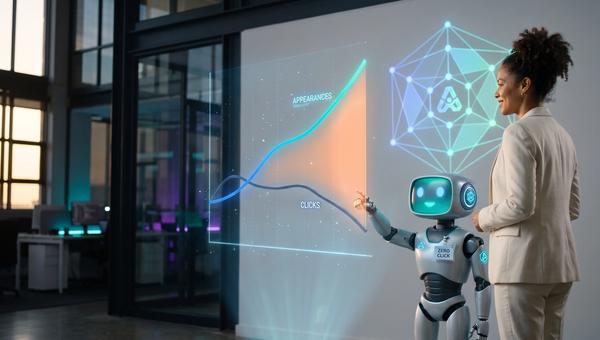
The headline finding is that being seen and being visited have come apart. Comparing the same 6 weeks a year apart, the typical business appeared 22% more often on mobile and received 8% fewer clicks. Put another way, it now takes a fifth more appearances in Google to earn the same visit.
Mobile appearances rose 22%. Clicks fell 8%.
Same 6 weeks compared year-on-year across 110 South African websites in Algorithm's zero-click study.
That's the number everyone reaches for. I think the more useful one is the other half of it: organic search still delivered 67.3 million clicks to those websites. The channel didn't stop working. What changed is how many appearances it now takes to earn one click, and where the rest of that attention went.
The attention didn't disappear, it got redistributed
When we checked the businesses' main non-branded page-one search terms against South African Google results, 70% of them showed an AI Overview, the AI-written answer Google now puts above the normal results. The terms carrying one lost 22% of their clicks per appearance over the year. The terms without one lost 9%. Average positions barely moved in either group, so this isn't businesses ranking worse. It's the same ranking, on a page that now answers the question before you get there.
And it's not only Google. Someone can read a summary of your pricing in an AI Overview, be recommended by ChatGPT when they ask who to use, or find you through a TikTok search, without a single one of those appearing in your traffic report as organic search.
This is the part I think the industry has been slow to say directly. We've spent two years arguing about whether AI is killing SEO, which is the wrong argument. The work that gets you quoted in an AI Overview is the work that gets you ranked: clear answers, structured content, facts a machine can lift, authority other websites confirm. The disciplines haven't diverged but the reporting has.
Ranking well does not mean you are being cited
There's a trap in that last paragraph worth pulling out here, because it's the thing most likely to catch a business that thinks it's already covered.
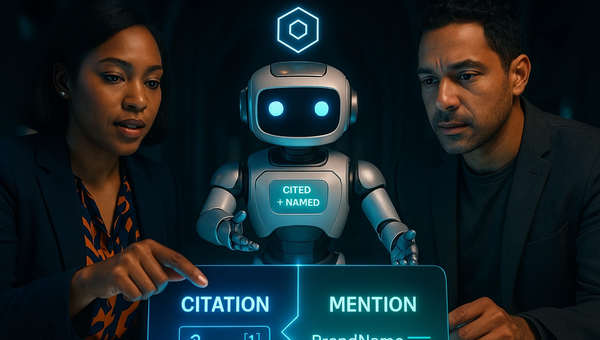
We run separate research on which sources AI engines actually cite in South Africa, across 170,720 citations. The finding that matters here: 87.8% of cited domains appear on only one engine. A brand ChatGPT trusts is usually invisible in Perplexity. Strong Google rankings do not carry across automatically either.
So "we rank well, so we'll be fine" is not supported by the data. Being found and being cited are now separate questions with separate answers, and only one of them shows up in Search Console.
Three things, one job
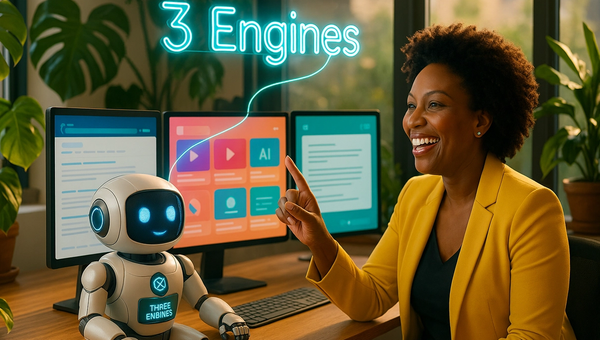
Here's the position I've landed on and stand firm in. Traditional SEO, answer engine optimisation and generative engine optimisation are not three channels. They're three outputs of one system, and that system runs on the same two inputs: content a machine can understand and reuse, and authority that makes it worth reusing.
Traditional SEO is the foundation and stays the foundation. Google's AI Overviews are built from the same index that produces the blue links. A page Google can't crawl can't rank and can't be quoted. If anything the technical basics matter more now, and there's a live trap here: some security configurations block AI crawlers by default, which means a business can be invisible to the engines it most wants to be cited by without anyone having made that decision.
AEO, answer engine optimisation, is about being quoted inside Google's answer. GEO, generative engine optimisation, is about being recommended when someone asks ChatGPT, Gemini or Perplexity. Different surfaces but the same underlying work. We've written up what that work actually involves and who it is for for anyone who wants the detail.
When you split those across three owners with three budgets and three reports, you get three teams optimising for three fragments of one results page, and nobody accountable for what the customer actually sees.
What this changes in practice
Three things, and the first is the one most businesses can do immediately.
Change the report before you change the strategy. Put appearances next to clicks every month, split branded from non-branded, and read mobile on its own. About 4 in 5 appearances in our study were on mobile, and desktop numbers have been distorted by automated traffic since late 2025. If clicks are the only figure in your report, a year like the one we measured reads as straightforward failure. It isn't. It's rising visibility converting differently, and those two situations call for opposite responses.
Measure whether you're being quoted, not just whether you rank. Take your 50 most valuable searches. Check which show an AI Overview and whether you appear inside it. Then ask the AI engines the questions your customers ask and write down who gets named. That's a morning's work and most businesses have never done it.
Give the whole thing one owner. Not one agency necessarily, but one person accountable for organic visibility across every surface, with a single plan behind it. The alternative is what I see constantly: an SEO team reporting rankings, a content team reporting pageviews, and a CMO who can't answer whether the business is more or less findable than it was a year ago.
The uncomfortable part
There's a version of this argument that is just agencies inventing new acronyms to sell new retainers, and marketers are right to be suspicious of it. AEO and GEO are mostly new labels on work that was already good practice.
But the measurement problem is real and it's new. Our study found that even branded searches, where someone types your company name, lost 16% of their clicks per appearance in a year. Nobody is getting an AI summary instead of visiting a business they went looking for by name. Something is changing about the results page itself, and a traffic report can't see it.
Organic search isn't dying. It's becoming harder to see.
The businesses that handle this well over the next two years will mostly be the ones that fixed their reporting first, because you can't manage a system you're only measuring one output of.
The full study, Zero-click search in South Africa, is free to read at algorithm.agency/research/zero-click-search-south-africa. No business, website or search term is named in it.