You have probably seen the phrase zero-click search somewhere this year. It describes a search that ends without anyone visiting a website, because Google answered the question on the results page itself.
It matters because almost everything your marketing plan assumes about organic search runs through one number: how many of the people who see you actually come to your site. If that number is moving, your traffic targets, your lead forecasts and your cost per acquisition are all moving with it, whether or not anyone has told you.
Everything written about zero-click search so far is about America. The numbers everyone quotes come from US data, and South African marketers have had to guess how much of it applies here. So we stopped guessing and measured it.
We look after the Google data for more than 100 South African websites, from banks and retailers to manufacturers and schools. We pulled 16 months of it, May 2025 to September 2026, and asked one question: when a South African business shows up in Google, how often does anyone actually click through?
The answer has changed a lot in a year.
One thing worth knowing before you read on. Google tells us two things about every search: how many times your business was shown, and how many people clicked through to your site. Being shown is not the same as being visited, and the gap between those two numbers is what this whole study is about.
1. You are showing up more. Fewer people are coming
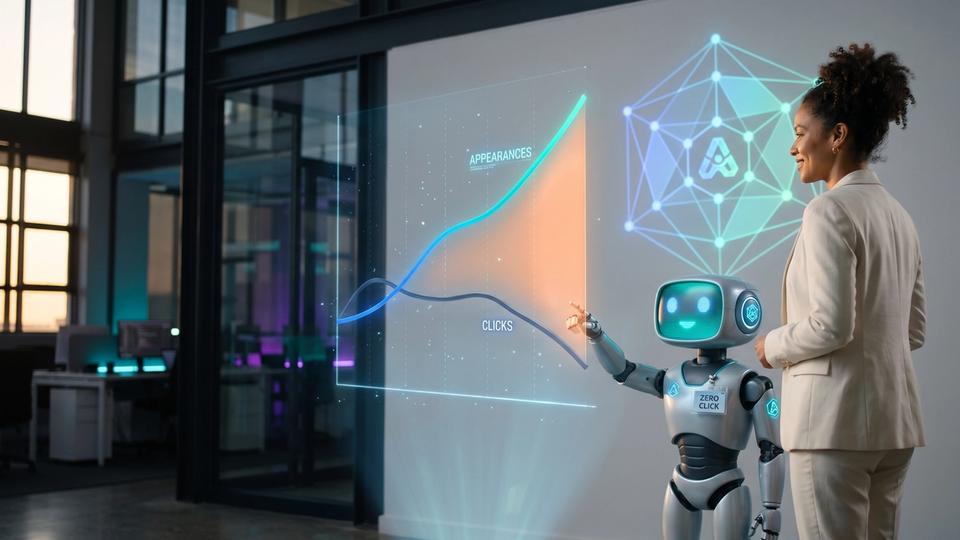
A year ago, the typical business in our study got about 5 visits for every 100 times it showed up in Google. Now it gets about 3.
Visits per 100 appearances in Google, year on year
Based on 16 months of Google Search Console data from 110 South African websites
That is the finding everything else sits under. On mobile, where 4 out of 5 of these searches happen, those businesses were shown 22% more often than the year before and got 8% fewer visits.
More eyes but fewer feet through the door.
For most of the businesses we looked at, both halves of that were happening at once. They were showing up for more searches, and each one was bringing fewer people.
2. Google is answering the question for you
This is the single biggest driver of zero-click search, and you have seen it already, even if you have not called it anything. AI Overviews are the AI-written answer Google now puts at the top of the page, above the normal results.
We checked nearly 6,000 of the searches these businesses rank on page one for, the ones where people are not typing a company name. 70% of them now show an AI Overview.
Most people assume these only turn up on question-type searches, the "how do I" and "what is" ones, and leave the commercial searches alone.
They do not. AI Overviews show up on 75% of buying searches and 75% of comparison searches, almost exactly as often as on questions. The only kind of search where they are rare is when someone is looking for a specific company by name.
3. The searches with an AI answer lost people twice as fast
We took the same searches a year apart and split them into two piles: the ones that show an AI Overview today, and the ones that do not.
The ones with an AI Overview lost 22% of their visits. The ones without lost 9%.
And this is not because those businesses slipped down the page. Their positions in Google barely moved. They are ranking just as well as they were and getting fewer people for it.
The damage is worst right at the top. If you hold the number one spot on a search with an AI answer above it, you are getting between 25% and 66% fewer clicks than you would on a search without one. That is a wide range because only 12 businesses in our study rank first often enough for a clean comparison, so treat it as a direction rather than a precise figure. Further down the page we found no real difference at all.
This matches what we saw in our earlier work on why your SEO does not make you visible in ChatGPT. Ranking well is no longer the same thing as being chosen.
4. Even people searching for you by name are not arriving
This one surprised us.
When someone types your company name into Google, that is your most valuable traffic by a distance. For the typical business in our study, those searches are only about 1 in 8 of the times it shows up, but they bring in roughly 3 out of every 4 visits.
They fell too, by 16%. The same number of people are searching for these businesses by name. Fewer of them are landing on the website.
That matters because it tells you AI is not the whole story here. Nobody reads an AI summary instead of visiting a company they went looking for on purpose. Something is changing about the Google results page itself, and it is pulling people in other directions before they reach your link.
5. The worst hit is where people are deciding between you and someone else
Every kind of search lost ground, but one stands out.
Comparison searches, where someone is weighing up options and prices before choosing, fell 34%. That is the biggest drop of anything we measured.
What makes it sting is how it happened. Those businesses were shown 39% more often on comparison searches. Visits only grew 5%. So all that extra visibility, right at the moment someone is choosing, brought almost nobody through the door.
That is also where AI Overviews show up on roughly 3 in 4 searches.
6. It is happening across every industry
We could report on seven industries. All seven are down, by somewhere between 15% and 50%.
Financial services came off worst at 37%, which makes sense: it is the industry that depends most on people searching for a brand by name, and those searches are falling.
Fashion, health and general retail held up best, down 15%.
Home, DIY and furniture retail is the one worth a second look. Their rate fell 29%, which sounds bad. But their actual visits grew 13%, because they were being shown 47% more often. They grew by casting a wider net, not by converting better. Whether that is a win depends on what those extra visits were worth.
So what should you actually do
Three things, in this order.
Fix your report before you change your strategy. Show how often you appeared next to how many people clicked, on the same page, and keep searches for your company name separate from everything else. If your monthly report shows visits alone, a year like this one looks like straightforward failure. It usually is not. It is more visibility turning into fewer visits, and that calls for a different response. We covered what this looks like at the top in the CMO's guide to board-ready marketing reporting.
Find out whether AI is mentioning you. Take your 50 most valuable searches. Check which ones have an AI answer sitting above them and whether your business gets named inside it. Then go and ask ChatGPT, Gemini and Perplexity the questions your customers ask, and write down who comes up. That is one morning's work and most businesses have never done it. If you want the lens on how to read what you find, start with citations vs brand mentions in AI search. Our wider study of 46,315 AI citations in South Africa breaks down which sources each engine actually trusts.
Give the whole thing to one person. Ranking in Google, getting quoted in AI answers and getting recommended by AI tools are not three separate jobs. The same work feeds all of them. Split them across three teams with three budgets and nobody can tell you whether customers are finding you more easily or less. We wrote about why search, social and AI need to run as one plan.
The part worth remembering
Google still sent 67.3 million visits to these 110 websites over 16 months. Search is not dying, and anyone telling you otherwise is selling something.
What has changed is how much visibility it takes to earn one visit. That is the number to plan against now, and most businesses are not measuring it yet.
Read the full study, free and with no sign-up. There is a section for each industry.
Short on time? The one-page brief covers what this means for paid media, organic search and AI search, with five things your team can start this quarter. It also comes as a PDF that prints on one page.
If you want to see what this looks like for your business, Algorithm runs the diagnostic on request.